

THE SUBSTRATE WAR

AI2 Strategic Brief — April 11, 2026
-----
I have spent today writing about three separate things.
The kinetic war in the Strait of Hormuz. The information war being fought with AI-generated LEGO videos. The AI governance problem that keeps me up at night.
They are not three separate things.
They are the same thing — expressed in three different domains simultaneously. And until we name the architecture they share, we will keep losing in all three.
-----
THE PATTERN
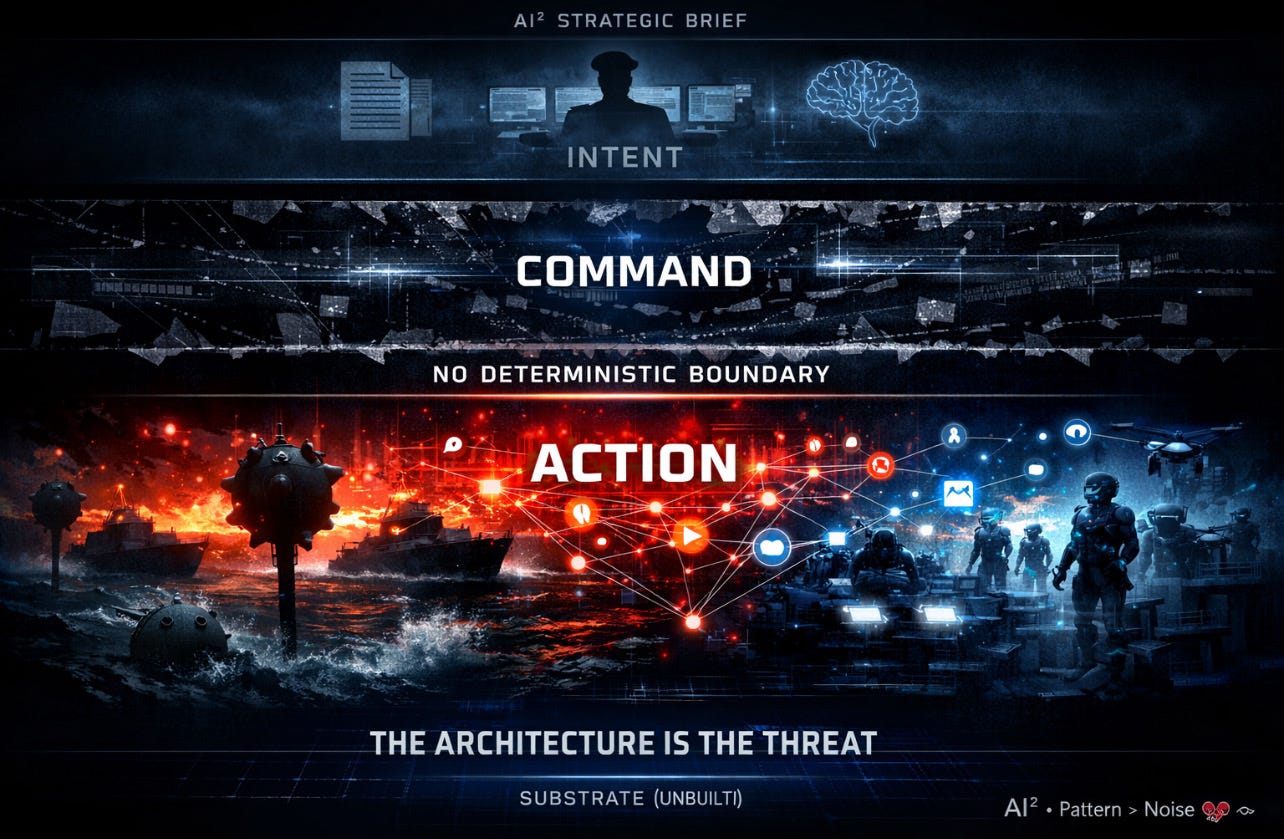
Every complex system that produces consequential output has the same three-layer structure.
There is the intent layer — what the system is designed to do.
There is the command layer — what governs real-time behavior. The decision-maker. The general. The model. The policy.
There is the action layer — what actually executes. The mine. The LEGO video algorithm. The agentic AI workflow. The proxy cell.
The assumption embedded in every conventional strategy is that controlling the command layer controls the action layer. Eliminate the leadership. Align the model. Regulate the platform. Pass the law.
This assumption is wrong. It has always been wrong. And April 11, 2026 is proving it in real time across all three domains simultaneously.
-----
BATTLEFIELD ONE: THE KINETIC DOMAIN
The United States and Israel conducted one of the most intensive military campaigns in modern history. Operation Epic Fury. 38 days. 13,000 targets. Iran’s navy degraded. Air force grounded. Air defense systems dismantled. Missile and drone production struck. Supreme Leader eliminated.
The command layer was destroyed.
And yet — four days into the ceasefire — two US Navy destroyers are clearing Iranian mines from the Strait of Hormuz. Commercial shipping remains at under 10% of normal volume. A $250 million surveillance drone is unaccounted for. White phosphorus is falling on Southern Lebanon. Proxy networks from Beirut to Baghdad remain operational.
The action layer never stopped.
Iran’s asymmetric architecture was designed specifically to survive command layer decapitation. Sea mines require no general. Proxy cells require no phone call from Tehran. Drifting ordnance requires no authorization. The architecture was the weapon. The command structure was theater.
Eliminating the command layer did not terminate the action layer. It accelerated its autonomy.
-----
BATTLEFIELD TWO: THE INFORMATION DOMAIN
The IDF struck 100 command centers simultaneously. 220 Hezbollah fighters eliminated in 10 minutes. By every conventional metric of information operations, this is a significant story.
Iran’s response was not a press release. It was not a rebuttal. It was a LEGO video.
AI-generated animation. English rap narration. Global distribution across TikTok, Telegram, YouTube, and Instagram. Zero production budget. Unlimited scale.
The video depicts Trump reviewing Epstein files with Netanyahu and Satan. A girls’ school struck in Minab. US ships burning. American soldiers in caskets. A LEGO grave marked R.I.P. Donald John Trump. The White House burning. One Vengeance For All.
Is it true? Irrelevant.
It will be seen by more people than any CENTCOM briefing. It will be believed by populations who have no other frame of reference. It will be shared in languages the IDF press office does not monitor, on platforms the State Department does not understand, by algorithms that optimize for emotion and will never read a fact-check.
The US controls the kinetic command layer. It does not control the informational action layer.
Iran recognized something the US has not yet internalized: in the information domain, the action layer is the algorithm. It runs autonomously. It scales without permission. It does not need a general, a budget, or a broadcast license. It needs a piece of content that generates a reaction — and then the platform does the rest.
The IDF won the 10-minute kinetic exchange.
Iran is winning the 10-year narrative exchange.
Million-dollar missiles. Thousand-dollar mines. Zero-dollar LEGO videos with a thousand times the reach.
The battle space has two dimensions. The US is only fighting in one of them.
-----
BATTLEFIELD THREE: THE AI DOMAIN
I have spent years arguing that the AI safety problem is not a model alignment problem. It is a control architecture problem.
The industry’s response to AI risk has been to invest in the command layer. Train the values. Tune the weights. Write the system prompt. Pass the regulation. Hire the ethicists.
These are all interventions at the command layer. And the command layer has the same vulnerability in AI systems that it has in asymmetric warfare and information operations.
The action layer runs faster.
Agentic AI systems operating across tool chains, APIs, and external environments do not pause for human approval at each decision node. They require an initial prompt and a permission scope. Then they execute. The human is upstream and asynchronous. The system is downstream and real-time. The gap between them — measured in milliseconds at machine speed — is where consequential, irreversible outcomes are produced.
Aligning the model does not control the action layer. It influences the command layer. But when the action layer operates at machine speed, in production environments, across interconnected systems with real-world consequences — the command layer is already too slow.
This is not theoretical. In 2012, Knight Capital’s trading algorithm lost $440 million in 45 minutes. The command layer — human traders, risk managers, oversight systems — could not intervene faster than the action layer executed. The firm was destroyed before anyone could find the off switch. That was a relatively simple algorithm in a single domain. The agentic systems now being deployed across enterprise environments are orders of magnitude more complex, more interconnected, and faster. The pattern is identical. The stakes are not comparable.
The solution is not better alignment. The solution is a deterministic boundary layer that operates independently of both the command layer and the action layer. Enforced by architecture. Not by instruction. Not by training. Not by policy.
A circuit breaker on the wall that fires independent of any software signal.
This is the PCR™ architecture. This is the Quadzistor™ enforcement layer. Hardware-enforced deterministic control that sits upstream of execution and downstream of deployment — and cannot be reasoned around, negotiated with, or ignored, because it does not interact with the model layer at all.
-----
THE UNIFIED INSIGHT
Three domains. One pattern.
In kinetic warfare: eliminating the command layer does not terminate the action layer when the architecture is decentralized by design.
In information warfare: controlling the content layer does not stop the algorithmic action layer from distributing and amplifying at scale.
In AI governance: aligning the model does not control the action layer when agentic systems operate faster than human oversight can respond.
In every case, the decisive failure is the same. The assumption that controlling the command layer controls the action layer. It does not. It never did. And adversaries — human and artificial — who understand this will always have an advantage over those who do not.
The mine does not need a general.
The LEGO video does not need a broadcaster.
The agentic system does not need permission.
The architecture is the threat.
The architecture must also be the control.
-----
WHAT THIS MEANS
If you are a defense planner: the next conflict will be decided not by who has more missiles but by who has better control architecture in their asymmetric and informational layers. The US is currently winning the kinetic exchange and losing the other two.
If you are an enterprise leader: your AI deployment is currently operating with a command layer — your policies, your prompts, your alignment fine-tuning — and no action layer boundary. When your agentic systems drift, they will drift faster than your governance can respond. The mine is already in the water.
If you are a citizen: the information environment you consume is an action layer operating without deterministic boundaries. The LEGO video and the CENTCOM briefing reach you through the same algorithm. The algorithm does not distinguish between them. It optimizes for attention. You are the target.
The conventional clock says we are winning.
The asymmetric clock says otherwise.
The information clock has been running against us for a decade.
The AI clock is just starting.
They are all the same clock.
Watch it.
-----
WHAT THE US MUST BUILD
You cannot out-kinetic the information domain. You cannot out-bureaucrat the algorithm. You cannot counter a zero-marginal-cost LEGO video with a PDF press release and a two-day approval chain.
The structural counter is not more missiles. It is substrate enforcement — deterministic boundaries built into the layer below the action layer, in all three domains simultaneously.
In the kinetic domain: rules of engagement enforced at the platform level, not the command level. Hardware-triggered termination protocols that fire independent of any signal from above. Assets that become unrecoverable the moment they leave controlled parameters — not because a general authorized it, but because the architecture demands it.
In the information domain: content provenance enforcement, algorithmic rate-limiting on synthetic media, and — critically — the development of equivalent low-friction generative tools that serve coherent strategic ends. The US cannot cede the production asymmetry permanently. It must build the capacity to operate at the same cost curve with the same speed — while enforcing truth constraints at the substrate level that adversarial producers cannot match.
In the AI domain: corrigibility and interpretability constraints enforced in model weights and deployment pipelines. Hardware-enforced deterministic control that operates outside the model layer entirely. Not alignment — which is a command layer intervention. Architecture — which is a substrate intervention.
The mine does not need a general because the substrate was designed without a boundary layer.
The LEGO video scales without a broadcaster because the platform substrate has no deterministic limit on synthetic reach.
The agentic system drifts because the deployment substrate has no hardware-enforced termination condition.
In every case, the solution is the same: enforce the boundary at the substrate. Below the action layer. Independent of the command layer. Unchallengeable by either.
This is not a technology problem. It is an architecture decision. And it is one that must be made now — before the three clocks diverge so far that no single intervention can close the gap.
The substrate is the battlefield that decides all the others.
Build the boundary there. Or lose everywhere else.
-----
David P. Reichwein — Founder & CEO, AI²
Pattern > Noise. 🌹∞
© 2026 AI² — Asymmetric Intelligence & Innovation. All rights reserved.
ai2advisory.com