

The Qualification Doesn’t Transfer
Gemini Robotics 2 moved the capability curve again this morning. The safety framework was overhauled last year and moved in the opposite direction. That divergence is the entire commercial question in

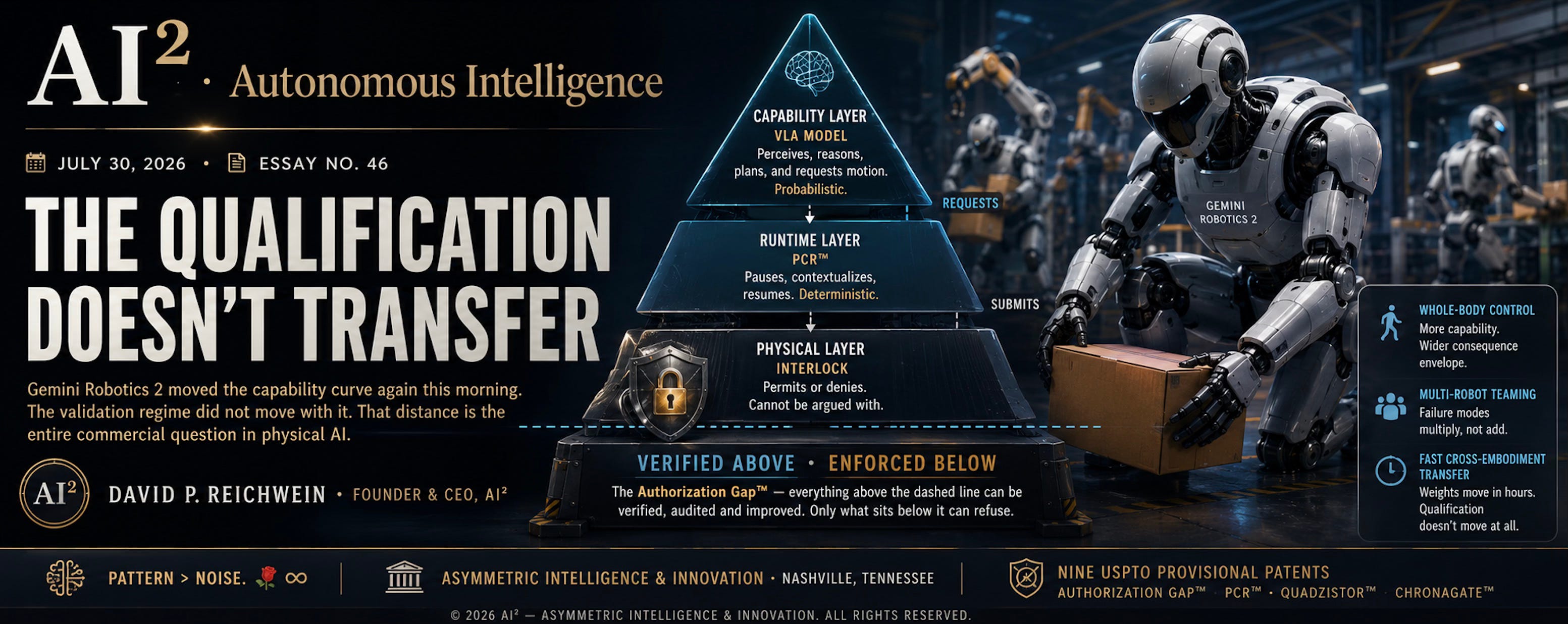
David P. Reichwein · Founder & CEO, AI²
AI² · Autonomous Intelligence — July 30, 2026 · Essay No. 46
Google DeepMind introduced Gemini Robotics 2 today. The headline capability is whole-body control: a humanoid that can walk, crouch, stretch and manipulate objects while reasoning through a multi-step task, rather than a pair of arms bolted to a fixed base. The release also includes an embodied reasoning model that plans tasks lasting several minutes and coordinates multiple robots working as a team, and an on-device variant that adapts to an entirely new robot body with a few hours of data.
It is a real advance. It is not the story.
The story is that every one of those three capabilities widens the gap between a system that works in a demonstration and a system that can be deployed under liability. Not one of them narrows it. And the third one — hours-fast adaptation to a new embodiment — is presented as the flagship feature when, under any serious fault-tolerance standard, it is the flagship exposure.
01 / THE WRONG METRIC
Success rate is not the number that matters
The reflexive framing in this industry is reliability as a percentage. Ninety-five percent in the lab, chase the last five percent, ship at five nines. I have used that framing myself. It is wrong, and it is worth saying plainly why.
Forty years in deterministic control systems — nuclear, aerospace, heavy industry, six continents — teaches a different discipline. In those environments nobody qualifies a system on how often it succeeds. They qualify it on what it does when it fails.
A picker that succeeds 97% of the time and never crushes a hand ships. A picker that succeeds 99.9% of the time and occasionally does something unrecoverable does not.
Those two systems are not separated by four tenths of a percent of capability. They are separated by an architecture. The first has a bounded failure envelope: every path out of nominal operation terminates somewhere safe. The second has an unbounded one — most of the time it is better, and the exception is not survivable.
Model capability improves the numerator. It does nothing to the envelope. The envelope is a structural property of the machine, established by the physical layer and the interlocks, and no amount of additional training data touches it.
Getting a robot to complete a task is an AI problem.
Getting that robot to fail survivably, every time, in an environment nobody controlled, is a systems engineering problem.
The first has been solved repeatedly and publicly. The second has not been solved once, by anyone, at scale.
02 / THE CASCADE
The framework isn’t missing. It’s pointed the other way.
There is a lazy version of this argument that says robotics has no safety standards. It does, they are mature, and they were rebuilt from the ground up eighteen months ago. The accurate version is worse for the industry than the lazy one.
February 2025 → ISO 10218-1 and 10218-2 are published in revised form, the first major overhaul of industrial robot safety in fourteen years. Most of ISO/TS 15066 — power-and-force limiting, speed and separation monitoring — is absorbed into Part 2 as normative text. The term “collaborative robot” is removed. Collaboration becomes a property of the application, not of the machine.
March 12, 2025 → Gemini Robotics and Gemini Robotics-ER launch on a Gemini 2.0 base — vision-language-action control with physical action added as an output modality. Access restricted to trusted testers.
June 24, 2025 → Gemini Robotics On-Device released — the same class of control, running locally on the machine rather than in a datacenter.
September 2025 → ANSI/A3 R15.06-2025 lands as the US adoption, replacing the 2012 edition.
July 30, 2026 → Gemini Robotics 2, ER 2 and On-Device 2. Whole-body humanoid control. Multi-robot teaming. One model checkpoint driving three different embodiments — an Apollo 2 with one hand system, the same Apollo 2 with another, and a fixed dual-arm platform.
Read those two curves against each other. The standards body spent eight years deciding that safety cannot be a property of a robot, because only an actual application can be designed, tested and confirmed as safe. In the same window, the model developers shipped a control policy whose defining virtue is that it is not bound to any particular robot or any particular application.
The standards moved toward binding safety to the configuration. The models moved toward being independent of it. Those are not two solutions converging. They are two vectors separating.
And humanoids sit further outside than that. ISO 10218 assumes a statically stable machine. Dynamically stable legged robots — which is to say, anything that walks — are the subject of ISO/WD 25785-1, which as of today remains a working draft. The whole-body humanoid control announced this morning is being shipped against a standard that has not been published.
03 / THREE CAPABILITIES, THREE WIDER ENVELOPES
Every headline feature enlarges the failure surface
Whole-body control
The robot’s own mass and balance enter the control loop. An upper-body error drops a cup. A whole-body error puts a machine of adult human mass on the floor — and possibly on a person. The consequence distribution gains a tail it did not have, and it is precisely the tail the published standard does not cover.
Multi-robot teaming
Coordinated systems do not add failure modes, they multiply them. Two machines sharing a task have a shared-state and coordination failure class that neither exhibits alone, and it is the class least likely to appear in a demonstration.
Fast cross-embodiment transfer
The weights move to a new body in an afternoon. The safety case does not move at all. This is the one that matters, and it is the one being sold hardest.
04 / THE CORE CLAIM
Weights are portable. Qualification is not.
In every regulated fault-tolerant domain I have worked in, the safety case is bound to a specific configuration. Not to a model. Not to a vendor. To this actuator, this sensor set, this operating envelope, this installed geometry. The 2025 revision codified exactly that instinct for robotics, which is why it stopped talking about collaborative robots and started talking about collaborative applications.
Change the actuator and you do not inherit the prior qualification. You requalify. Change the end effector and the force envelope changes, so the pinch analysis changes, so the guarding changes, so the emergency stop timing changes. This is not bureaucratic drag. It is the accumulated memory of everything that has killed people in industrial settings, written down.
Which brings the announcement into focus. One checkpoint driving an Apollo 2 with one hand system, the same Apollo 2 with a different hand system, and a fixed dual-arm platform is presented as evidence of generality. Read it as an engineer instead: three distinct force envelopes, three distinct kinematic chains, three distinct pinch-point geometries, three distinct failure signatures — one control policy, portable in hours.
Now try to place that inside the standard. There is nowhere for it to sit. A transferable policy is not an application. It is a thing that generates applications, faster than any of them can be qualified.
Generalization across embodiments is a capability claim. Under a safety standard it is a scope expansion without a corresponding validation. The faster the policy transfers, the further ahead of its own qualification it runs.
The industry has this backwards. It treats hours-fast embodiment transfer as the thing that makes deployment easy. It is the thing that makes deployment hard, because it detaches the software artifact from the physical configuration that the safety case was ever written against.
05 / THE GAP, IN THE VENDOR’S OWN DOCUMENTATION
Where responsibility actually lands
I do not need to construct this argument from the outside. It is stated in the developer documentation.
DeepMind’s own robotics guidance tells developers that despite the safety work in the model, maintaining a safe environment around the robot is the developer’s responsibility — because generative models make mistakes and physical robots can cause damage. The same guidance recommends, for high-precision work, querying the model multiple times and averaging the results.
Read those two together. That is the Authorization Gap™ written in plain English by the party best positioned to know it exists.
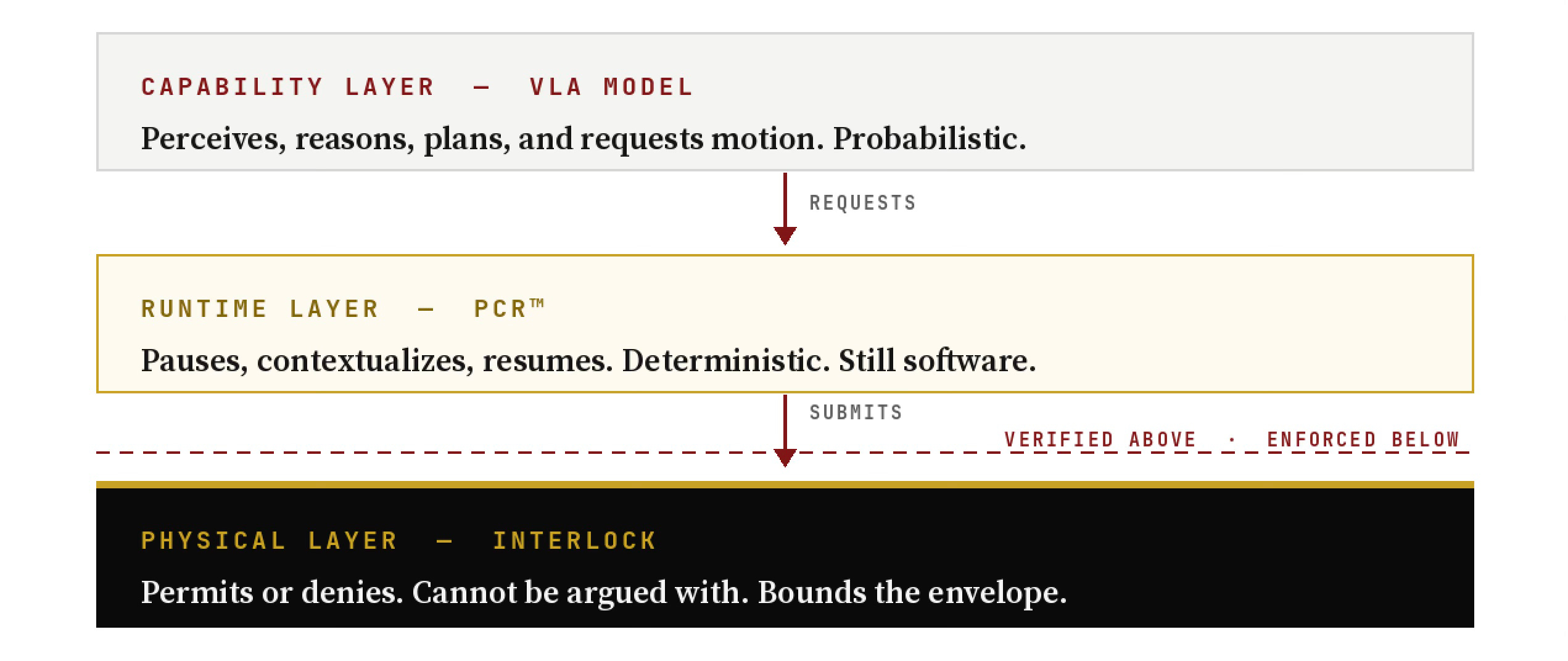
The Authorization Gap™ — everything above the line can be verified, audited and improved. Only what sits below it can refuse.
Averaging repeated queries is a probabilistic mitigation. It reduces variance. It does not create a bound. You cannot average your way to a safety case, because the failure that matters is not the average one — it is the one at the tail, in the configuration nobody sampled, with a person inside the swept volume.
And the vendor is being straightforward about this. They are not claiming to have closed the gap. They are correctly telling the integrator that the gap is theirs to close. The problem is that the market is reading the demonstration video and not the documentation.
One requirement follows, and it is the whole specification
The layer that refuses must not interpret.
This is the part that gets skipped, and skipping it is how the entire exercise becomes theater. If the thing that denies a motion is itself a model evaluating whether that motion is acceptable, nothing has been bounded. The probabilistic layer has been relocated one level down and given a safety label. A gate that reasons about whether to open is not a gate. It is a second opinion with more authority than the first.
An enforcing layer has to be dumb enough that its complete behavior is enumerable before it ever runs. Fixed limits. Fixed geometry. Fixed response. No inference at the boundary. Whatever sits above it can be as capable as anyone can make it — that is the trade, and it is a good one. Intelligence above the line, determinism below it.
Every deployment architecture in physical AI should be readable against that single question: is the thing that can say no capable of being talked out of it?
06 / WHAT THIS MEANS COMMERCIALLY
The last five percent is not five percent of the cost
In fault-tolerant engineering the ratio is well understood by anyone who has priced a qualification program. Getting the function to work is a minority of the total engineering spend. Proving what it does at the edges — hazard analysis, failure modes and effects, redundancy design, interlock validation, environmental qualification, the documentation trail that survives a deposition — is the majority.
Nothing about attaching a language model to the front of that changes the arithmetic. If anything it worsens it, because a policy that generalizes across embodiments has a larger input space to characterize than one that was hand-tuned for a single cell.
Capability improves the average case. It scales with data and compute.
Envelope bounds the worst case. It scales with hardware and validation only.
Liability is priced off the worst case. It is indifferent to the average.
This is why the companies that win physical AI will not be the ones with the best demonstration. They will be the ones who can hand an insurer, a plant safety officer, and eventually a regulator a bounded failure envelope with evidence behind it.
→ Model quality is becoming a commodity input. Three labs will have comparable VLA capability within eighteen months.
→ The scarce asset is the qualification apparatus — the standards, the test regimes, the interlock architecture, the incident data.
→ Whoever owns that apparatus sets the terms for everyone shipping on top of it, regardless of whose model is inside.
07 / FALSIFICATION LEDGER
What would change my position
A claim that cannot be broken is not an argument. Here is what would break this one.
→ ISO/WD 25785-1 publishes with a workable treatment of transferable control policies — a revalidation gate that triggers on embodiment change rather than on application change alone. The central claim weakens substantially and I would say so in print.
→ A major integrator publishes twelve months of incident data from uncontrolled environments — not benchmark scores, not demonstration footage — showing bounded-consequence failure that holds across embodiment changes.
→ A humanoid deployment reaches meaningful scale around unprotected people with a public safety case bound to the physical configuration rather than to model performance. The thesis is wrong in its strong form.
What would not change my position: a better demonstration, a higher benchmark, a more impressive video, or another capability release. Those are measurements of the numerator.
08 / BASE CASE
Where this lands
Physical AI capability is real and accelerating faster than most people tracking it expected. The demonstrations are not fake. The models are not hype in the technical sense.
But a large fraction of what is being priced right now is capability being mistaken for deployability, and the two are separated by an engineering discipline this cycle has not yet had to learn. That discipline is expensive, slow, unglamorous, and non-optional. It was non-optional in aviation. It was non-optional in nuclear. It will be non-optional here, and it will be learned the same way it was learned in those industries — which is the part worth working to prevent.
The people who wrote the 2025 revision already know all of this. They spent eight years arriving at the conclusion that safety belongs to the application, not the machine. The industry shipping on top of them has not read it.
Capability tells you what the machine can do.
The envelope tells you what it cannot do — and that is the only half a deployment decision rests on.
Software asks. Hardware enforces.
Gemini Robotics 2 moved the first half forward this morning. The second half is where the physical AI market will actually be decided, and almost nobody is building it.
David P. Reichwein — Founder & CEO, AI²
Pattern > Noise. 🌹∞
Asymmetric Intelligence & Innovation · Nashville, Tennessee
Nine USPTO provisional patents · Authorization Gap™ · PCR™ · Quadzistor™ · ChronaGate™
© 2026 AI² — Asymmetric Intelligence & Innovation. All rights reserved.
ai2advisory.com
ai2library.com