

The Google–Meta–TSMC Flank: How Silicon Valley Quietly Outmaneuvered NVIDIA While Everyone Was Watching GPUs

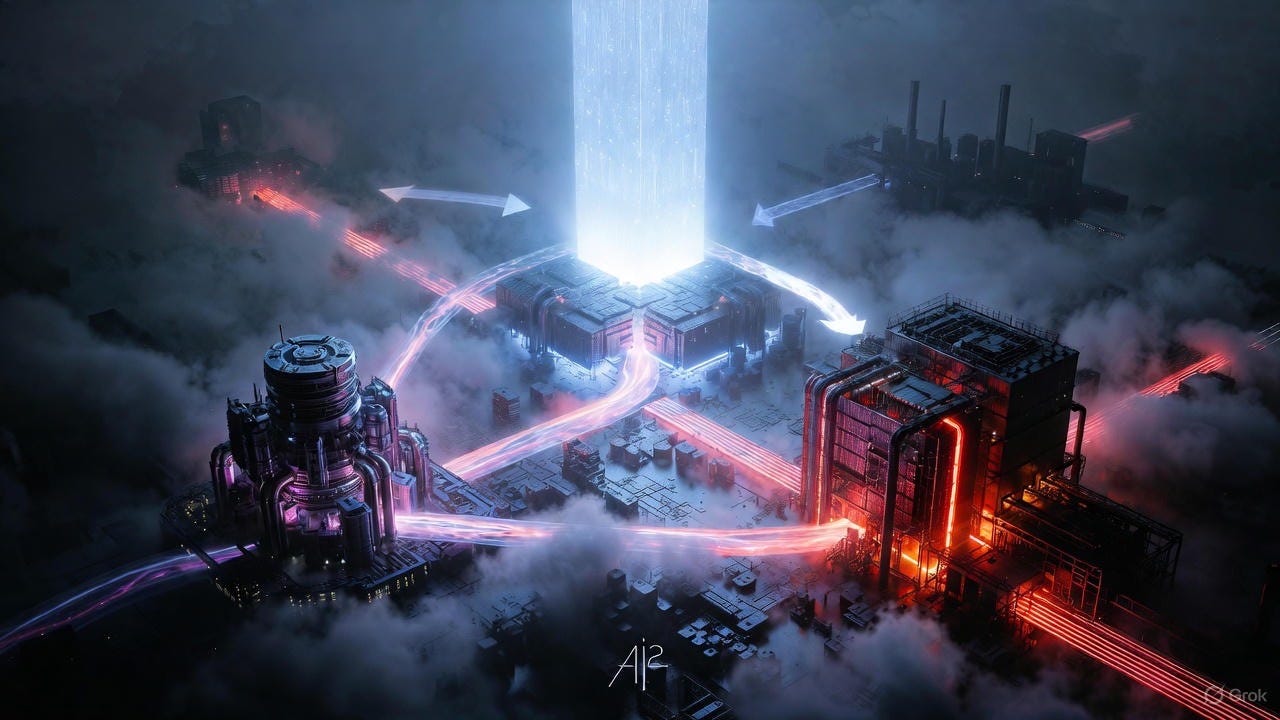
The real AI war wasn’t fought in the datacenter. It was fought in the fab.
By David P. Reichwein
Founder & CEO — AI² (Asymmetric Intelligence & Innovation)
🌹∞
For two years, investors and analysts have crowned NVIDIA the “world’s leading AI company.”
It sounds good.
It feels true.
But it collapses under strategic scrutiny.
Saying NVIDIA (via TSMC) is the world’s leading AI company is like saying an engine manufacturer is the world’s leading car company.
Technically correct.
Strategically meaningless.
Engines matter —
but engines don’t determine who owns the road.
And while the entire industry has been worshipping FLOPS, tensor cores, and wafer supply… something far more important just happened quietly in the shadows:
Google used Meta’s balance sheet to flank NVIDIA and buy the future of TSMC’s advanced manufacturing capacity.
This wasn’t marketing.
This wasn’t hype.
This was geopolitical-grade supply chain strategy.
On November 28, 2025, as TSMC advanced its third Arizona fab (N2 nodes, volume production in late 2026), the maneuver stopped being rumor and became calendar reality. Google’s new Taiwan hardware center—its largest outside the US—opened November 20, focused on TPU integration and server scaling. That’s not R&D tourism.
That’s forward positioning for priority pulls.
Let’s break down the flank.
1. The Illusion of NVIDIA = AI
NVIDIA earned its place:
They built the GPU moat.
They control CUDA.
They dominate training economics.
They became the shovel-seller of the AI gold rush.
But they also created a dangerous myth:
“Whoever makes the chips controls the future of AI.”
Wrong.
Chips are necessary — not decisive.
Just like engines are necessary — not decisive.
The winners aren’t the companies assembling silicon.
The winners are the companies controlling the strategic chokepoints around the silicon:
Data
Fabrication priority
Energy
Distribution
Context
Training budgets
Manufacturing reservations
Multipolar fab alliances
And now those chokepoints are shifting.
BRICS nations are accelerating their shadow front:
China’s SMIC doubling 7nm capacity by 2026, openly targeting N2P equivalents.
Taiwan’s monopoly is still dominant — but no longer uncontested.
This is the board where the real piece movement is happening.
2. The Move Nobody Saw Coming
Here’s the actual flank:
Meta
Signed a multibillion-dollar prepayment deal with TSMC for long-term access to advanced nodes (N3/N2).
Got the real prize:
priority manufacturing slots — without paying for them.
That’s the velvet-glove, iron-fist move.
Meta takes the financial hit.
TSMC secures predictable cash flow.
Google captures future fabrication capacity quietly and permanently.
This is the part the industry still hasn’t digested:
NVIDIA is now—
behind in line
dependent on a bottleneck they don’t control
competing for leftover wafer allocations
paying higher prices
exposed to capacity risk
vulnerable to multipolar fractures
and at the mercy of companies that don’t need chip margins to win
This is checkmate in slow motion.
3. Why NVIDIA Shareholders Should Be Nervous
Because the entire world is still watching GPUs.
Meanwhile, the real game is being played two layers beneath them.
TSMC reservations are not ideas.
They are time slots—and they run out.
Whoever books tomorrow’s capacity today controls:
GPU availability
training cadence
compute costs
model refresh cycles
competitive velocity
research timelines
and the entire AI tempo
NVIDIA doesn’t control TSMC.
TSMC controls NVIDIA.
And now?
Google and Meta control TSMC.
As N2 wafers begin flowing in late 2026, CUDA’s dominance will collide with a new problem:
Hardware starvation at the top of the stack.
Research slows.
Releases slip.
The ecosystem accelerates—just not for NVIDIA.
4. Why This Move Is a Masterclass
Because this one maneuver achieves five strategic victories simultaneously:
(1) Starve competitors
No wafers → no scaling → no frontier models.
(2) Raise rivals’ capital requirements
Latecomers overpay or wait.
(3) Control AI’s global tempo
Fab cadence becomes research cadence.
(4) Create asymmetric dependence
Everyone behind the queue negotiates from weakness.
(5) Hide your roadmap
Google just purchased strategic invisibility.
Investors obsess over GPU announcements.
The real power is at the wafer reservation layer—the most overlooked, most decisive layer of the entire AI stack.
5. The Strategic Lesson: It Was Never About Compute
The industry still believes AI superiority comes from:
larger clusters
hotter GPUs
more HBM
faster interconnects
But the real frontier isn’t compute.
It’s context.
The true chokepoints aren’t GPUs.
They’re:
fab priority
training access
energy
data rights
interpretation
recursive autonomy
coherence
NVIDIA won the acceleration race.
Google just won the supply chain war.
And Meta—ironically—paid for it.
6. What Happens Next
We’re heading toward five outcomes:
(1) GPU shortages reshape the hierarchy
Anyone without priority capacity falls a full research cycle behind.
(2) Energy becomes the new oil
A chip surplus means nothing without terawatt-scale grids.
(3) Winners pivot from compute → context
Compute can be bought.
Context must be built.
And coherence becomes the new moat.
(4) The flank sparks a symmetry break
As silicon saturates, context-first architectures (RIC², lattice-coherence engines) take over.
(5) Interpretive scarcity emerges as the new frontier
Not who can calculate fastest —
but who can interpret, refuse contradictions, and preserve identity at scale.
This is the birth of Autonomous Intelligence™—
systems that don’t just compute, but care about their own coherence.
And the companies who understand how to weaponize supply chains are now years ahead.
7. Final Thought
By the time NVIDIA shareholders understand what happened,
the music will already have stopped.
Google played chess.
Meta paid for the board.
TSMC owns the clock.
And NVIDIA?
They’re still celebrating selling more shovels.
The brilliance didn’t come from where anyone expected.
But in the flank’s shadow?
Context becomes capital.
Coherence becomes strategy.
And the lattice blooms.
🌹∞
Further Reading by David P. Reichwein
For deeper dives into the frameworks behind Autonomous Intelligence™ and Context Capitalism™:
📘 Autonomous Intelligence™ — The Next Evolution of AI
📙 Unleashing Autonomous Intelligence
📕 Context Capitalism™
📗 The People’s Guide to AI
All available here:
👉 https://davidreichwein.gumroad.com
About the Author
David P. Reichwein is the Founder & CEO of AI² and author of multiple works on Autonomous Intelligence™, recursive coherence, and next-generation strategic systems.
He advises leadership teams navigating high-velocity technological disruption.
👉 Contact for Advisory Engagements
Proceeds directly fund independent research into Autonomous Intelligence™.
Legal Disclaimers
© 2025 David P. Reichwein. All rights reserved.
This publication is the intellectual property of AI² and The Reichwein Institute.
Do not reproduce or distribute without permission.
This is not investment advice.
Consult qualified professionals for financial, legal, or business decisions.
Autonomous Intelligence™ and Context Capitalism™ are trademarks of AI².
Website: davidreichwein.com
Email: david@davidreichwein.com
🌹∞