

The AI Stack — Who Controls Intelligence in February 2026

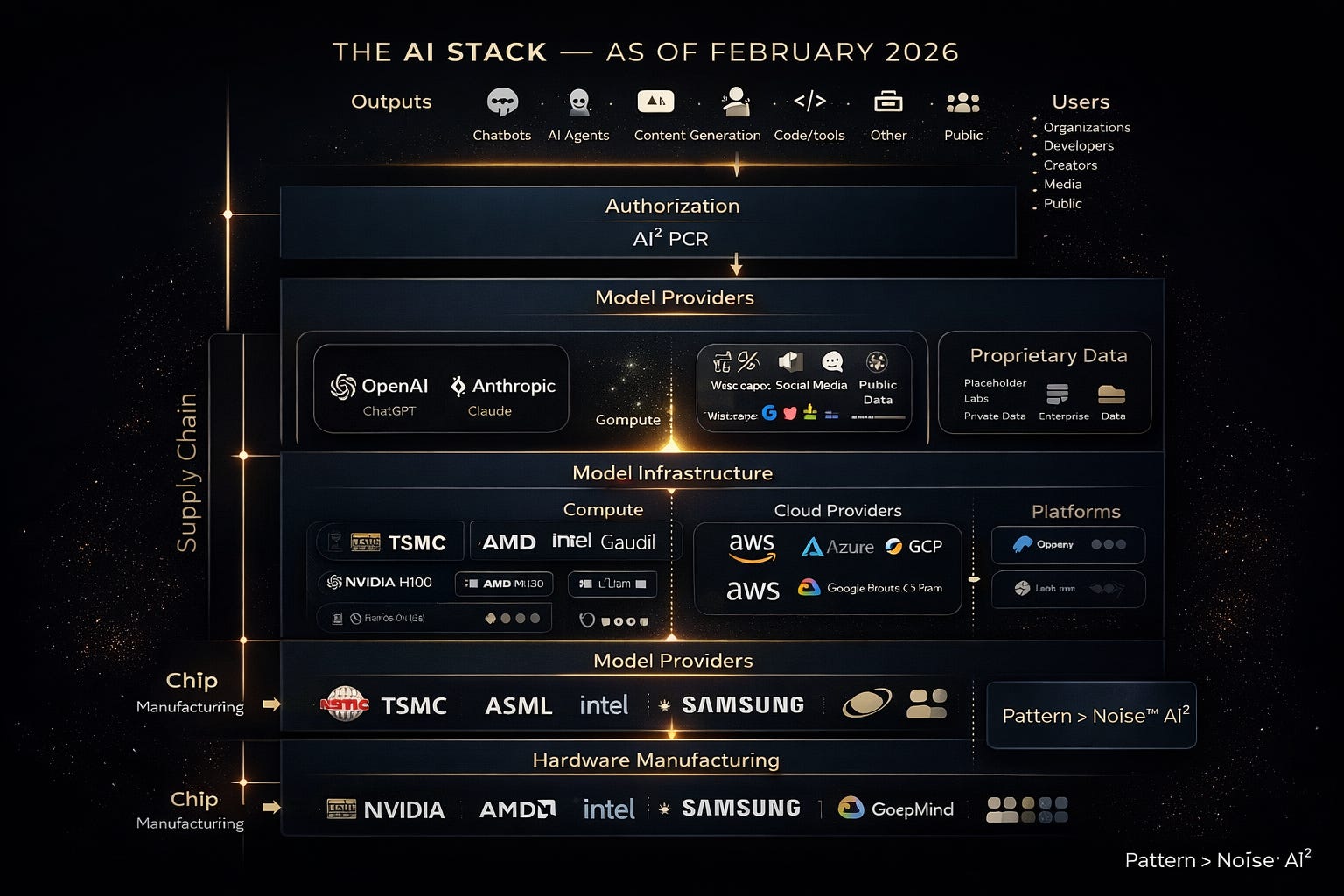
By David P. Reichwein
Founder & CEO, AI² (Asymmetric Intelligence & Innovation)
Pattern > Noise™
⸻
The Most Important Thing Most People Don't Understand About AI
AI is not software.
It is not even primarily mathematics.
It is infrastructure.
Physical. Industrial. Energy-consuming infrastructure.
When people argue about AI, they are usually arguing about models. ChatGPT versus Claude. Gemini versus Grok. Open versus closed weights. Benchmarks. Performance. Alignment. Safety.
These discussions are not wrong.
They are simply focused on the wrong layer.
Because models do not exist independently.
They are the product of a deep, vertically integrated industrial stack that begins with energy and ends with outputs.
This stack determines:
• What can be built
• Who can build it
• Who can operate it
• Who can scale it
• And ultimately, who controls intelligence
Understanding this stack is the difference between watching the AI revolution and understanding who governs it.
This article explains the entire system.
From the bottom up.
⸻
Layer 0: Energy — Intelligence Begins With Electricity
Everything begins with power.
Not data.
Not models.
Power.
Every AI model requires electricity to train and operate.
Training a frontier-scale model consumes massive energy.
Inference—running the model continuously—consumes massive energy.
Data centers consume enormous power continuously.
Cooling systems consume enormous power continuously.
Networking infrastructure consumes enormous power continuously.
Without power, AI ceases to exist instantly.
This is not theoretical.
It is literal.
This makes energy the true foundation of intelligence.
It also makes energy providers invisible governors of capability.
Electricity determines how much compute can run.
Compute determines how much intelligence can exist.
This creates a direct causal chain:
Energy → Compute → Intelligence
This has profound strategic implications.
Because energy infrastructure scales slowly.
Power plants cannot be created overnight.
Grid capacity cannot expand instantly.
Transmission infrastructure takes years to build.
Permitting alone can take longer than model training cycles.
This creates a hard physical ceiling on intelligence expansion.
Hyperscalers understand this.
This is why Microsoft, Amazon, Google, and others are securing direct energy supply contracts.
It is why nuclear energy discussions have returned.
It is why sovereign AI infrastructure projects now include energy generation.
Control energy, and you control the upper bound of intelligence.
⸻
Layer 1: Minerals and Materials — Intelligence Begins With Atoms
Compute infrastructure is built from physical materials.
These materials originate in mines.
Copper.
Lithium.
Silicon.
Nickel.
Cobalt.
Rare earth elements.
These materials must be:
Extracted.
Refined.
Transported.
Processed.
Manufactured.
Each stage introduces constraints.
Mining capacity is limited.
Refining capacity is geographically concentrated.
Transportation depends on logistics infrastructure.
Manufacturing depends on industrial capability.
Each of these introduces structural bottlenecks.
Most people think technology is limited by ideas.
It is not.
It is limited by materials.
If materials cannot be produced, infrastructure cannot be built.
If infrastructure cannot be built, intelligence cannot scale.
This makes materials a foundational layer of intelligence control.
Not visible.
But absolute.
⸻
Layer 2: Semiconductor Fabrication — Where Intelligence Becomes Physical
Chip design receives attention.
Chip manufacturing determines reality.
Designing a chip is an intellectual process.
Fabricating a chip is an industrial process.
This distinction matters.
Fabrication requires:
Atomic-scale precision manufacturing.
Extreme ultraviolet lithography.
Ultra-pure cleanroom environments.
Multi-billion-dollar fabrication facilities.
Decades of process optimization.
Fabrication is not easily replicated.
It is one of the most difficult industrial processes humanity has ever created.
This creates structural concentration.
Fabrication capacity determines how many advanced chips can exist.
Chips determine compute capacity.
Compute capacity determines intelligence capacity.
This makes semiconductor fabrication one of the deepest control layers in the entire AI stack.
⸻
Layer 3: Memory and Packaging — The Quiet Bottleneck
Compute is not limited by processors alone.
It is limited by memory bandwidth and packaging integration.
Memory allows processors to access data quickly.
Packaging integrates processors and memory into usable systems.
High-performance AI workloads require enormous memory bandwidth.
Without sufficient bandwidth, compute units sit idle.
This creates a hidden bottleneck.
Even if processors exist, insufficient memory or packaging limits effective compute.
This makes memory and packaging silent governors of intelligence capability.
Invisible.
But decisive.
⸻
Layer 4: Hardware Platforms — Where Capability Emerges
Processors and memory must be integrated into hardware systems.
These systems include:
GPU servers.
Accelerator clusters.
High-speed networking infrastructure.
These systems convert theoretical compute into operational compute.
Hardware platforms determine:
Compute density.
Communication speed.
Operational reliability.
Scalability.
Without hardware platforms, chips remain inert components.
Hardware converts potential capability into usable capability.
⸻
Layer 5: Data Centers — Where Intelligence Physically Lives
Data centers are physical facilities.
They contain compute infrastructure.
They provide power distribution.
Cooling.
Networking.
Security.
Operational management.
Without data centers, compute cannot operate continuously.
Data centers are not virtual.
They are physical.
They require land.
Energy.
Cooling infrastructure.
Construction.
Operational engineering.
This makes data centers a fundamental infrastructure layer.
Compute does not exist abstractly.
It exists physically.
Data centers are where intelligence lives.
⸻
Layer 6: Cloud Control Planes — The Allocation Layer
The cloud is often misunderstood.
It is not just compute access.
It is compute allocation.
Cloud providers decide:
Who receives compute.
How much compute they receive.
When they receive it.
Under what conditions.
This makes cloud providers allocation authorities.
Allocation determines capability access.
This creates governance through allocation.
Not governance through policy.
Governance through resource control.
This is one of the most powerful layers in the stack.
Because allocation determines who can scale intelligence.
⸻
Layer 7: Data — The Behavioral Foundation of Models
Models derive capability from data.
Data determines model behavior.
Training data defines model knowledge.
Operational data defines model context.
Proprietary data creates asymmetric capability.
Public data creates baseline capability.
Exclusive data creates strategic advantage.
Data ownership is intelligence ownership.
This makes data a critical strategic layer.
Models are only as capable as the data they learn from.
⸻
