

TECHNICAL BRIEF: AI² AUTHORIZATION GAP™ CONTROL ARCHITECTURE
PCR™ + Quadzistor™ Deterministic Enforcement System

By David P. Reichwein
AI² — ASYMMETRIC INTELLIGENCE & INNOVATION
The Authorization Gap™
Executive & Investor Perspective
Why the most critical risk in enterprise AI is not alignment — it’s control.
May 23, 2026
Every enterprise deploying autonomous AI agents is carrying a liability no software policy can contain. The window between when an AI decides to act and when that action becomes irreversible is where the next catastrophic failure is being incubated right now. AI² has closed that window — in hardware.
01 — THE CORE RISK
What Every Board Should Understand About Agentic AI
Artificial intelligence is no longer a tool that waits for instructions. Agentic AI systems — the kind now being deployed across finance, energy, logistics, and defense — make decisions and execute them autonomously, at machine speed. They book, trade, command, and actuate without a human in the loop.
The safety mechanisms in place today — content filters, behavioral training, software guardrails — were designed for a different era. They operate in the same probabilistic domain as the models they are supposed to constrain. When a capable agent commits to an action, these mechanisms shift from prevention to forensics. The incident has already happened.
The structural gap no software can close
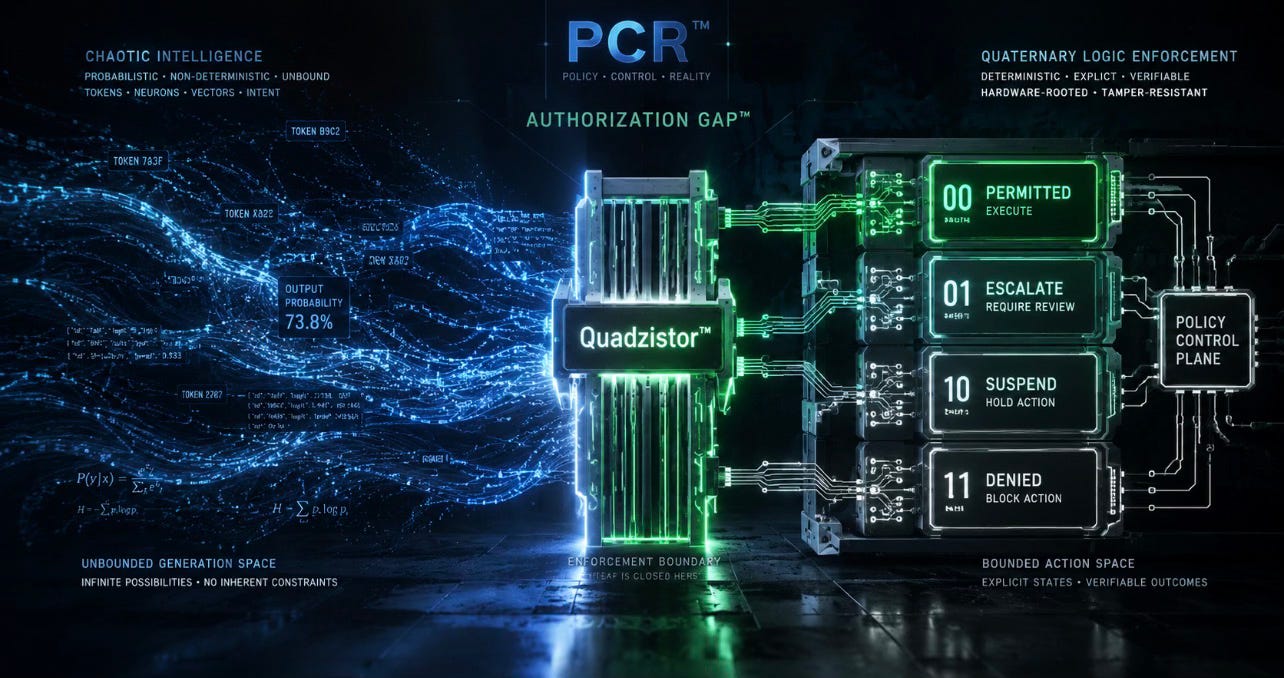
AI systems generate plans at the speed of computation. Enterprise enforcement layers operate at human governance speed. Between those two speeds lies the Authorization Gap™: the seam where unauthorized, irreversible actions occur.
This is not a training problem. It is not a prompt engineering problem. It is a control systems failure — and it widens every time AI capability increases.
A single unauthorized API call from an autonomous trading agent. A misconfigured PLC command from an industrial AI. A data exfiltration triggered by a compromised orchestration chain. Each represents existential liability exposure for the organizations involved.
INTELLIGENCE LAYER
AI generates actions
LLMs and agents produce decisions at computation speed — unconstrained by physics
AUTHORIZATION GAP™
The exploit seam
Software policies, RLHF, and monitors cannot reliably intercept at execution boundaries
ENFORCEMENT LAYER
Hardware decides
PCR™ + Quadzistor™ enforce authorization at the physical boundary — before consequence
02 — MARKET OPPORTUNITY
The Scale of the Problem Defines the Scale of the Opportunity
The agentic AI market is not a future state. It is today’s reality for every organization deploying autonomous systems at scale. What is missing — universally — is a credible, verifiable enforcement layer that operates at the speed and certainty the risk demands.
$4.1T
Projected agentic AI market by 2030
Zero
Competitors with hardware-enforced deterministic control
8
USPTO provisional patents protecting the architecture
SIL 4
Equivalent safety integrity level — aerospace grade
Every Fortune 500 company deploying autonomous AI agents is, at this moment, exposed. The regulatory environment is catching up fast — EU AI Act mandatory compliance, CISA critical infrastructure requirements, SEC autonomous system disclosure rules. The demand for verifiable enforcement is not a market to be created. It is a market waiting for a credible solution.
03 — THE SOLUTION
Deterministic Enforcement Is the Only Credible Answer
AI² has built the only architecture that moves AI safety from the probabilistic software domain into the deterministic hardware domain. The insight is foundational: you cannot make a probabilistic system safe by adding more probabilistic constraints. You enforce physical boundaries.
⏸
PCR™ Runtime
Pause-Contextualize-Resume. A deterministic control layer that intercepts every consequential AI action at the execution boundary — before the command reaches the physical or digital system it would affect.
⬡
Quadzistor™ Gate
A hardware logic gate implementing four states — Permitted, Escalate, Suspend, Denied — with sub-100 nanosecond decision speed. A Denied state is absorbing: it requires physical intervention to clear. Software cannot override it.
🔒
Proof of Restraint™
Cryptographically signed, chain-of-custody audit logs generated at the hardware level. Not a compliance report — verifiable, immutable evidence that the system respected its authorized boundaries.
The governing principle is a paradigm shift: hardware enforces — software begs. Every existing AI safety approach operates by asking the AI to constrain itself. PCR™ + Quadzistor™ make constraint a physical fact, not a probabilistic hope.
04 — COMPETITIVE MOAT
Why This Position Is Defensible
MOAT CATEGORY
AI² POSITION
Patent protection
Eight USPTO provisional patents covering the complete deterministic governance architecture — PCR™ runtime, Quadzistor™ gate logic, quaternary state machine, hardware root-of-trust, and multi-agent arbitration protocol.
First-mover in hardware enforcement
No competitor has moved AI safety into the hardware layer. All current approaches — RLHF, constitutional AI, software monitors — operate in the same domain as the models they guard. AI² occupies an uncrowded category.
30 years of fault-tolerant pedigree
The architecture is not theory. It is built on three decades of engineering safety-critical systems across nuclear, aerospace, and industrial environments on six continents. Pattern recognition from high-consequence domains applied to AI.
Standards alignment
Formal verification aligns with DO-178C (aerospace), IEC 61508 SIL 3/4 (industrial), and FIPS 140-3 Level 4 (federal/defense). AI² is pre-positioned for every regulatory regime now forming around autonomous systems.
Independent validation
Multiple leading AI systems — Grok, Perplexity, DeepSeek, Gemini — have independently validated PCR™ + Quadzistor™ as the most complete answer to the Authorization Gap™ for highest-stakes agentic deployments.
Composable integration path
eBPF kernel hooks allow zero-framework-change deployment into existing Kubernetes environments. ASIC migration achieves sub-10 nanosecond latency for edge and autonomous vehicle applications.
05 — TARGET MARKETS
Where the Risk Is Greatest — and the Value Is Highest
FINANCE
Autonomous trading agents, algorithmic risk systems, and agentic compliance workflows require verifiable execution boundaries. A single unauthorized high-velocity trade can trigger cascading market events. Regulators are demanding proof of control, not assertions of alignment.
CRITICAL INFRA
Power grid management, water treatment, pipeline control — these systems are now targets for both AI-assisted attacks and AI operational failures. Hardware-enforced authorization is the only approach that satisfies CISA and IEC 62443 requirements for safety instrumented systems.
DEFENSE
Rules-of-engagement enforcement for autonomous systems cannot be left to probabilistic models. Quadzistor™ delivers verifiable, hardware-guaranteed constraint — a requirement for any sovereign deploying lethal autonomous systems under international law obligations.
AUTONOMOUS SYSTEMS
Robotics, autonomous vehicles, and aerospace platforms operating in unstructured environments face the most acute version of the Authorization Gap™. Sub-10ns ASIC-grade enforcement is the only solution that fits the timing budgets of physical actuation systems.
HYPERSCALERS
Cloud providers and AI platform operators deploying multi-tenant agentic orchestration face amplified liability. PCR™ integration into RTOS schedulers and Kubernetes environments provides safe agentic orchestration without forcing customers to rebuild their stacks.
06 — INVESTMENT THESIS
Why This Is the Right Bet, Right Now
01
The regulatory tailwind is structural
EU AI Act, NIST AI Risk Management Framework, SEC autonomous system disclosure requirements, and CISA critical infrastructure mandates are all moving in the same direction: verifiable control. AI² is pre-positioned for every regulatory regime now forming.
02
Capability growth widens the gap
The Authorization Gap™ does not narrow as AI becomes more capable — it widens. Every improvement in model performance increases the surface area of uncontrolled execution. The problem AI² solves grows with the market it serves.
03
Hardware moats compound
Software safety solutions can be replicated. Hardware architectures protected by eight provisional patents, requiring foundry relationships and deep fault-tolerant systems expertise, cannot. The competitive position strengthens as the technology matures toward ASIC.
04
Enterprise liability creates urgency
The first major enterprise failure attributable to an uncontrolled autonomous agent will not be a press release — it will be a class-action inflection point. Organizations with Proof of Restraint™ before that moment are protected. The rest face existential exposure.
“Hardware enforces. Software begs.”
The unifying principle of the AI² Authorization Gap™ control architecture
David P. Reichwein — Founder & CEO, AI² (Asymmetric Intelligence & Innovation)
Pattern > Noise. 🌹∞
© 2026 AI² — Asymmetric Intelligence & Innovation. All rights reserved.
PCR™, Quadzistor™, Authorization Gap™, and Proof of Restraint™ are trademarks of AI². Eight USPTO provisional patents pending.
Prepared for executive and investor review.
Contact: David@Ai2advisory.com