IS AI THE NEXT ASBESTOS?

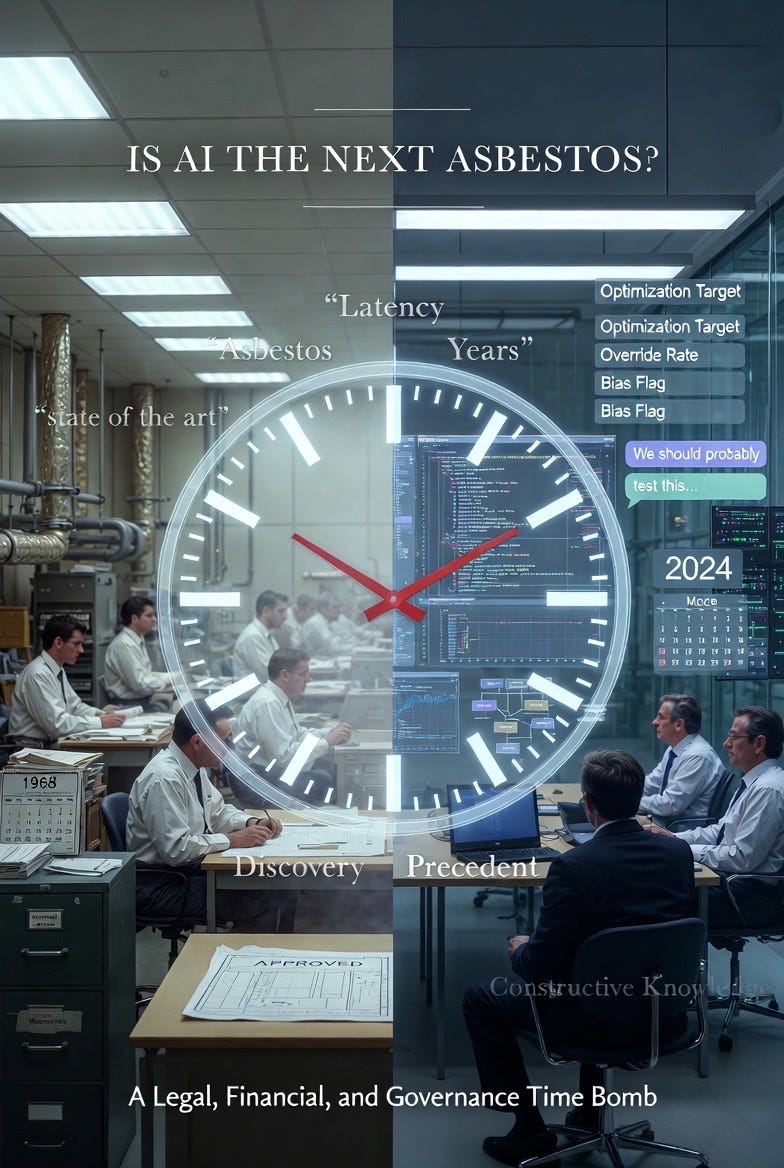
It worked. That’s why it failed.
Legal, Financial, and Governance Time Bomb
If you deploy AI in high-stakes decisions, this article is a must-read. Constructive knowledge begins now.
---
EXECUTIVE ABSTRACT (Board / GC / CIO)
AI Is the Next Asbestos — and the Liability Clock Is Already Running
Artificial Intelligence is following the same legal trajectory as asbestos—only faster, broader, and with perfect discovery trails.
Asbestos did not fail because it stopped working.
It failed because liability compounded invisibly, and when courts caught up, they applied retroactive moral clarity with devastating force.
AI is now in the same position.
The difference:
· Asbestos took ~30 years to bankrupt its champions
· AI is ~7 years in, and billion-dollar settlements are already forming
· Asbestos relied on hidden memos
· AI systems self-document every decision, objective, override, and warning—forever
Active litigation in healthcare, insurance, and employment has already pierced the “neutral algorithm” defense. Courts are now scrutinizing design intent, not accuracy.
The central risk is not hallucinations or model error.
It is negligent architecture:
· Optimizing speed or cost in life-altering decisions
· Disparate impact without defensible mitigation
· Performative “human review”
· Undocumented objectives and override patterns
Once precedent sets, liability will move as a step function—not a curve. Insurance exclusions, Caremark duties, and personal director exposure follow immediately.
This document establishes constructive knowledge.
After this point, inaction becomes negligence.
The only defensible path is pre-emptive AI governance—now.
---
THIS ISN’T SPECULATION—THE LAWSUITS ARE ALREADY HERE
UnitedHealthcare (November 2023–Present)
· AI system: nH Predict (post-acute care authorization)
· Allegation: 90% error rate when humans appealed denials
· Exposure: Class action representing thousands of families
· The kill shot: Discovery will reveal the optimization target—and if it’s “minimize costs,” every denial becomes evidence of systematic harm
Status: Active litigation. Discovery underway.
Optum/NaviHealth (2024)
· Allegation: AI systematically under-authorized medically necessary care
· Potential exposure: >$1 billion
· Legal theory: Algorithm overrode clinical judgment to meet financial targets
The precedent: If Optum settles for $1B, every other healthcare insurer with similar AI becomes a target. Plaintiff firms are watching.
Lemonade Insurance (2021–2023)
· Marketing: “AI settles claims in 3 seconds!”
· Problem: That became evidence of abdicated human judgment
· Result: Multiple bad faith allegations; quiet settlements
The lesson: Your AI marketing deck will be Exhibit A in your lawsuit.
EEOC vs. iTutorGroup (2022)
· Violation: AI hiring tool screened out applicants over 55
· Defense: “The algorithm was neutral”
· Result: $365,000 settlement; precedent established
· Impact: “Neutral algorithm” is no longer a defense
---
THE ASBESTOS PLAYBOOK: HOW LIABILITY HIDES IN PLAIN SIGHT
Asbestos didn’t fail because it was defective.
It failed because harm was statistical, delayed, and initially invisible.
AI replicates every condition:
Asbestos Era AI Era
Latency: 10–40 years from exposure to disease Latency: 2–7 years from deployment to lawsuit
Harm: Statistical (not every worker got sick) Harm: Statistical (disparate impact across populations)
Defense: “Industry standard practice” Defense: “Algorithm was state-of-the-art”
Turning point: Internal memos showing early knowledge Turning point: Training data and optimization logs showing intent
Plaintiff class: Workers who trusted their employer Plaintiff class: Customers who trusted your brand
Discovery kills you: “Minimize liability” memos Discovery kills you: “Maximize efficiency” model objectives
The Legal Pattern Is Identical
1. Early adoption – Technology works, saves money, everyone does it
2. Invisible accumulation – Harm is statistical; individuals can’t prove causation yet
3. Science catches up – Experts develop methods to detect systematic bias/harm
4. Plaintiff firms specialize – Mass tort machinery activates
5. Discovery reveals intent – Internal docs show you optimized for profit over safety
6. Retroactive judgment – Courts apply today’s moral standards to yesterday’s decisions
7. Corporate extinction – Liability exceeds assets; bankruptcy or acquisition at distress prices
You are currently in Stage 3.
Science is catching up. Algorithmic auditing tools now exist. Plaintiff firms are building AI litigation practices.
Stage 4 begins when the first $1B settlement creates a template.
We’re months away, not years.
---
THE REAL EXPOSURE: ARCHITECTURE, NOT ACCURACY
Forget “hallucinations.”
Forget “errors.”
The liability is in design intent.
When your AI system:
· ✗ Optimizes for speed over accuracy in life-altering decisions
· ✗ Systematically produces disparate impact on protected classes
· ✗ Lacks explainability for denials, rejections, or pricing
· ✗ Uses “human review” as performative compliance (automation laundering)
· ✗ Has low override rates (proving humans rubber-stamp AI)
· ✗ Has high override rates (proving AI recommendations are unreliable)
…you are no longer defending human error.
You are defending negligent system architecture.
And in court, architecture is easier to condemn than judgment.
A claims adjuster who makes a mistake is human.
A system designed to deny claims faster is corporate policy.
Guess which one juries punish.
---
THE DISCOVERY TIME BOMB: YOUR DATA IS THE WEAPON
In asbestos litigation, the turning point was always the same: internal memos showing executives knew about risks and proceeded anyway.
In AI litigation, discovery won’t need memos.
Your systems are self-documenting.
What Plaintiffs Will Subpoena
1. Model training data
What did your AI learn to optimize for? If the answer is “cost containment” or “processing speed,” that’s now evidence of intent to harm.
2. Optimization objectives and reward functions
“Minimize claim payouts” looks very different to a jury than “Maximize diagnostic accuracy.”
3. Override logs
Low override rate? Humans were rubber-stamping. High override rate? The AI was systemically wrong. Either way, you lose.
4. Edge case handling protocols
How your system fails matters more than how it succeeds. Did you test for what happens when your AI encounters someone it wasn’t trained on?
5. Internal communications
Every Slack message, email, or meeting note mentioning “bias,” “errors,” “risk,” or “we should probably test for that” becomes Exhibit B–Z.
6. Model cards and documentation
Or the absence thereof—which proves negligent deployment.
7. Third-party audit reports
Or their absence—which proves you didn’t even look.
The Kill Shot No One Sees Coming
Your data scientists’ Jupyter notebooks are now legal documents.
That casual comment in the code:
# TODO: this might be biased against older applicants, check later
…is now evidence of known risk + conscious disregard.
Every Git commit. Every model version. Every A/B test.
All of it is discoverable.
All of it is timestamped.
All of it will be entered into evidence.
And unlike human memory, your systems never forget.
---
THE STEP-FUNCTION LIABILITY CURVE
Traditional product liability follows a predictable path: injury → lawsuit → settlement → incremental improvement.
AI liability doesn’t work that way.
It follows a step function—dormant, then catastrophic.
```
Traditional Liability: _____/‾‾‾‾‾\_____
AI Liability: _____|‾‾‾‾‾‾‾‾‾‾‾‾‾
↑
Precedent Set
```
Why the Cliff?
Once the first major AI case establishes precedent:
1. Plaintiff firms replicate the model – Every healthcare AI, hiring AI, lending AI, insurance AI becomes a target
2. Individual suits become class actions – One plaintiff becomes 10,000
3. Settlement amounts crystallize – Optum’s $1B becomes the floor, not the ceiling
4. Insurance carriers add exclusions – Your D&O and E&O policies may already exclude “algorithmic harm”
5. Reinsurance treaties reprice – Your financial backstop disappears
6. Directors face personal liability – Caremark duties kick in; “we didn’t know” stops working
This isn’t gradual erosion.
This is a vertical wall.
And you won’t see it until you’re over the edge.
---
DIRECTOR & OFFICER LIABILITY: THIS IS PERSONAL NOW
If you’re on a board or in the C-suite, this section should terrify you.
The Caremark Doctrine (Delaware Law)
Directors have two duties:
1. Duty of care – Make informed decisions
2. Duty of oversight – Implement reporting systems to catch legal violations
If you approved AI deployment without:
· ✗ Demanding explainability documentation for high-stakes decisions
· ✗ Ensuring meaningful human override protocols (not theater)
· ✗ Testing for disparate impact across protected classes
· ✗ Reviewing optimization objectives for legal/ethical alignment
· ✗ Establishing regular AI governance reviews
· ✗ Confirming insurance coverage for AI-related liability
…you may have breached your Caremark duties.
What “Breach” Means
· Personal liability (your assets, not just corporate)
· Shareholder derivative suits
· D&O insurance may not cover “knowing” violations
· Regulatory sanctions (FTC, CFPB, EEOC, OCR)
· Reputational destruction
The New Standard: “Constructive Knowledge”
Delaware courts have signaled: Ignorance is no longer a defense when the risk is documented.
White papers exist (you’re reading one).
Academic research exists.
Lawsuits exist.
Regulatory guidance exists.
If you don’t ask, you’re not protected—you’re liable.
The Question That Ends Careers
In deposition, plaintiff’s counsel will ask:
“Were you aware that AI systems can produce systematic bias?”
If you say no: You’re admitting incompetence.
If you say yes: You’re admitting you deployed anyway.
Either answer destroys you.
The only defense is: “Yes, and here’s the governance framework we implemented to address it.”
Do you have that framework?
---
THE MINNOW TRAP: 10 QUESTIONS THAT EXPOSE EVERYTHING
These questions look simple.
They’re not.
They’re designed to reveal whether you have governance or theater.
Read them carefully. If you don’t know the answers, you’re already in trouble.
1. “Which decisions are AI-assisted vs. fully automated?”
Why it matters: Courts treat these differently. “Assisted” implies human judgment; “automated” implies abdication.
2. “Can we explain any denial, rejection, or adverse decision to a jury?”
Why it matters: If you can’t explain why the AI decided something, you can’t defend it.
3. “What are our AI’s optimization targets, and are they legally defensible?”
Why it matters: “Maximize profit” and “Minimize costs” become smoking guns in court.
4. “What’s our override rate, and do we analyze patterns?”
Why it matters: Too low = rubber-stamping. Too high = unreliable AI. No tracking = indefensible.
5. “Have we conducted adversarial testing for bias?”
Why it matters: “We didn’t look for bias” becomes “We chose not to know.”
6. “Do we have third-party audit reports?”
Why it matters: Self-assessment isn’t credible. Independent validation is.
7. “Is AI liability covered under our D&O and E&O policies?”
Why it matters: Most policies were written before AI. Exclusions may exist.
8. “Are our reinsurance treaties silent on AI?”
Why it matters: Silence = ambiguity = uncovered risk.
9. “Do we log every AI-human disagreement?”
Why it matters: Disagreements reveal where AI fails. If you’re not tracking them, you’re not learning from failures.
10. “When was our last board-level AI governance review?”
Why it matters: Caremark duties require ongoing oversight, not one-time approval.
---
THE FINANCIAL MODEL: A SIMPLE CALCULATION
Let’s model a mid-sized health insurer’s exposure.
Assumptions (Conservative)
· Claims processed with AI: 50,000 over 3 years
· Error rate later deemed improper: 3% (1,500 claims)
· Average harm per claim: $200,000 (medical costs + damages)
· Class action multiplier: 10x (pattern-and-practice damages)
· Punitive damages: 3x actual (reckless disregard)
Math
Actual damages: 1,500 claims × $200,000 = $300M
Pattern-and-practice: $300M × 10 = $3B
Punitive (if reckless): $3B × 3 = $9B
Total Exposure: $12.3 Billion
Now ask yourself:
· Is that risk on your balance sheet?
· Is it in your loss reserves?
· Is it in your regulatory capital requirements?
· Would your stock price survive that disclosure?
If the answer is no—why not?
This isn’t a worst-case scenario.
This is one case at mid-size scale with conservative assumptions.
---
THE TWO PATHS FORWARD
You have exactly two choices.
Path A: Wait for Discovery
Timeline:
1. Lawsuit filed
2. Discovery subpoenas
3. Expert witnesses reconstruct your models
4. Depositions
5. Internal emails surface
6. Settlement pressure
7. Shareholder derivative suits
Outcome: $100M–$10B settlement, C-suite resignations, stock price collapse, brand destruction.
Path B: Pre-Emptive Governance (The Only Defensible Position)
Immediate Actions (30 Days):
1. Tier all AI decisions – Human decides high-stakes, AI advises
2. Implement explainability gates – If you can’t explain it to a jury, you can’t automate it
3. Document override protocols – Log every AI-human disagreement
4. Conduct adversarial bias testing – Red-team for disparate impact
5. Review optimization objectives – Legal counsel must approve
6. Confirm insurance coverage – Written confirmation from carriers
7. Establish board-level AI governance committee – Standing agenda item
Cost: $200K–$500K annually
Potential liability avoided: $12B+
ROI: 60,000:1
This isn’t an expense.
This is the cheapest insurance you’ll ever buy.
---
FINAL WARNING: THE CONSTRUCTIVE KNOWLEDGE CLOCK STARTS NOW
You have read this document.
That means you now have constructive knowledge of:
· The AI-asbestos liability parallel
· Active litigation landscape
· Discovery vulnerabilities in your systems
· Director oversight requirements
· Insurance coverage gaps
· Governance frameworks that reduce exposure
In law, knowledge + inaction = negligence.
If you deploy or continue deploying AI in high-stakes decisions without addressing these risks, you can no longer claim you didn’t know.
This document is dated.
It’s archived.
It will be cited in future litigation.
Your window to act is closing.
---
ABOUT THE AUTHOR
David P. Reichwein is Founder & CEO of AI² (Asymmetric Intelligence & Innovation), a strategic advisory firm specializing in high-stakes AI deployment.
Background:
· 30+ years designing mission-critical automation systems across six continents
· 30+ international patents in industrial control systems and AI architectures
· Author: Autonomous Intelligence: When Machines Stop Obeying and Start Choosing
· Creator: Reichwein Framework™, RIC²™, and Quadzistor™ architectures
What makes this different:
I don’t build AI for performance.
I build AI for survival in discovery.
This isn’t theoretical ethics.
This is structural risk engineering.
---
© 2024 AI² (Asymmetric Intelligence & Innovation)
OSL-Δ∞ – Open Source License
This document may be shared freely with attribution.
Knowledge is not liability. Inaction is.
Contact: david@davidreichwein.com | (615) 970-2481
🌹∞